A scratch on a caravan, a cracked motorhome bumper or a suspicious dent left by an enthusiastic awning pole can quickly take the shine off your next trip.
The good news is that many types of exterior and interior damage can be repaired without replacing an entire panel, bumper, shower tray or piece of furniture. The less good news is that leisure vehicles are built from a surprisingly varied collection of materials, and the correct repair is not always as simple as filling the damage and applying something approximately white.
Damage Fix helps caravan, campervan and motorhome owners understand their repair options and request quotations from suitable mobile and workshop repair specialists.
Whether your vehicle has suffered a minor scrape, cracked GRP, a damaged body panel, a broken corner moulding or an interior surface repair, you can send us photographs and details of the damage through our quotation service.
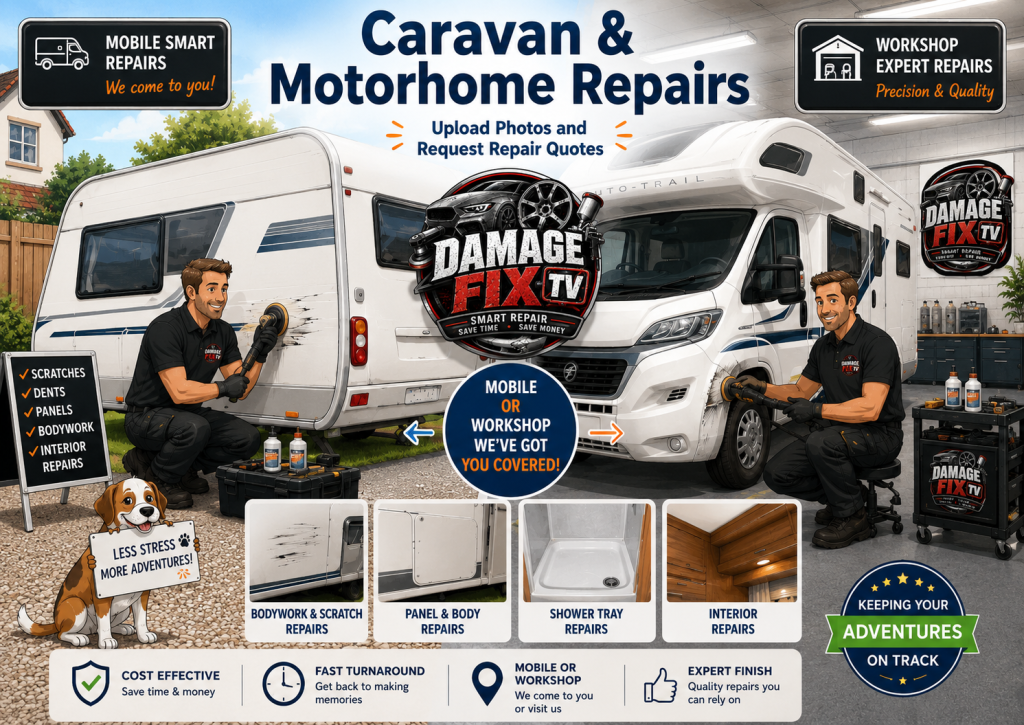
Caravan or motorhome damage?
Upload clear photographs, tell us where the vehicle is located and explain what happened. We can then use the information to help identify the type of repairer likely to be required.
Upload Photos and Request Repair Quotes
Photograph-based assessments and quotations may be provisional. Some damage needs to be examined in person before the full extent and final repair price can be confirmed.
What Are Caravan and Motorhome SMART Repairs?
SMART stands for Small to Medium Area Repair Technology.
In the motor industry, the term is normally associated with localised repairs to paintwork, bumpers, wheels, dents and interior trim. The same principle can be applied to many areas of caravans and motorhomes, although leisure vehicles bring their own materials, construction methods and occasional mysteries.
A caravan or motorhome SMART repair usually aims to repair a damaged area without replacing a much larger component unnecessarily.
Examples can include:
- Localised caravan panel damage
- Scratches, scuffs and paint damage
- Small punctures or holes
- Motorhome GRP and fibreglass damage
- Cracked plastic bumpers and skirts
- Damaged corner mouldings
- Shower tray cracks
- Sink and washbasin damage
- Worktop chips and burns
- Interior wallboard damage
- Cupboard and furniture repairs
- Vinyl, plastic and trim repairs
The important word is suitable.
A SMART repair is not automatically the correct answer simply because the visible damage appears small. Damage near structural joints, windows, mounting points or panel seams may require more investigation. Water ingress, extensive delamination and serious accident damage can also turn an apparently modest blemish into a much larger repair.
In my experience, customers often describe caravan damage as “only a little dent”. That may be completely accurate—or it may be a dent, a crease, stretched aluminium, damaged graphics and a slightly distorted rail all attending the same party.
Good repair advice begins with identifying what has actually been damaged.
Caravan SMART Repairs
Caravans are lightweight by design, which is excellent when towing them but less helpful when they meet gateposts, branches, awning poles or the corner of the house.
Caravan SMART repairs can include exterior bodywork, internal surfaces and moulded bathroom components.
Common caravan exterior repairs
Typical enquiries include:
- Awning-pole dents
- Textured aluminium panel damage
- Smooth-sided panel dents
- Scratches and abrasions
- Small holes and punctures
- Damaged corner mouldings
- Lower skirt damage
- Wheel-arch damage
- External locker damage
- Hail and storm damage
- Scratched or damaged decals
- Damage around handles and fittings
The repair method will depend on the construction of the caravan, the position of the damage and whether the panel has been stretched, creased or punctured.
Read our complete Caravan SMART Repair Guide for a more detailed explanation of the available repair methods.
Caravan panel repair
Repairing a caravan side panel is not quite the same as repairing a steel car door.
Many caravan panels are thin, lightweight and bonded as part of a larger structure. Some have a textured finish that must be reproduced during the repair. Others are smooth and painted, while newer models may use GRP or composite materials.
A small localised repair may be possible where:
- The damage is accessible
- The panel remains structurally sound
- Water has not entered the construction
- The damaged area can be stabilised
- A suitable finish can be achieved
- The repair will not interfere with a seam or fixing point
Larger creases, extensive delamination, widespread hail damage or damage affecting panel joints may require a workshop inspection or complete panel replacement.
For more information, visit our Caravan Panel Repair Guide.
Caravan dent repair
Caravan dents can range from shallow depressions to sharp creases and impact damage.
The position of the dent is particularly important. Damage in the centre of a clear panel may offer more repair options than damage running into a window frame, awning rail, locker opening or panel edge.
Textured aluminium presents an additional challenge because the pattern must be reproduced convincingly. A repair that looks reasonable in flat light can sometimes become much more obvious when the sun catches it from the side.
Learn more in our guide to Caravan Dent Repair.
Caravan scratches and paint damage
Caravan scratches may affect:
- Paint
- Gelcoat
- Aluminium skin
- GRP
- Decals
- Plastic mouldings
A light surface mark might polish out. A deeper scratch may need filling, refinishing or localised paintwork. If a scratch crosses a decal or printed graphic, the graphic may also need replacing or carefully reproduced.
Before reaching for a touch-up pen designed for a 2007 hatchback, it is worth establishing what the caravan surface is made from.
Read our Caravan Scratch and Paint Repair Guide.
Motorhome SMART Repairs
Motorhomes combine elements of cars, commercial vehicles, caravans and small houses. As a result, motorhome body repairs can involve metal cab panels, painted GRP, moulded plastics, composite bodywork, aluminium, furniture and bathroom components.
Common motorhome SMART repairs include:
- GRP cracks
- Fibreglass corner damage
- Rear bumper repairs
- Side-skirt repairs
- Wheel-arch damage
- Scratches and paint damage
- Cracked plastic mouldings
- Damaged locker doors
- Cab body repairs
- Interior surface repairs
- Shower tray and sink repairs
- Worktop and furniture repairs
Our Motorhome SMART Repair Guide explains these repair categories in more detail.
Motorhome GRP and fibreglass repairs
GRP—glass-reinforced plastic—is widely used for motorhome body panels, roof sections, corners and moulded components.
It is commonly called fibreglass, although a professional repair involves more than brushing resin over a crack and hoping nobody looks too closely.
A proper GRP repair may involve:
- Inspecting the extent of the cracking
- Removing weak or damaged material
- Reinforcing the area
- Rebuilding the correct shape
- Refinishing the surface
- Matching the existing colour and gloss
- Replacing affected graphics where necessary
Fine surface cracks may be limited to the outer finish. Other cracks may indicate impact damage, movement, stress around a fixing point or weakness from an earlier repair.
Cracks should be assessed before water is allowed to enter or repeated movement causes the damage to spread.
Visit our Motorhome GRP and Fibreglass Repair Guide.
Motorhome bumper and corner repairs
Replacement motorhome bumpers, skirts and corner mouldings can be costly, slow to obtain or no longer available for older models.
Depending on the material and condition of the component, repair may be possible where it has:
- Split or cracked
- Been scraped
- Lost a small section
- Pulled away from a mounting
- Become distorted
- Suffered localised impact damage
The repairer must inspect more than the visible crack. Mounting points and supports behind the component may also be broken or distorted.
This is another area where photographs can be deceptive. A bumper may appear to have a single crack from the outside while several mounting points are waving a small white flag behind it.
See our Motorhome Bumper Repair Guide.
Caravan and Motorhome Construction Materials
Understanding the material is central to choosing the correct repair method.
Two panels may look almost identical from a few feet away but require entirely different preparation, reinforcement and refinishing techniques.
Textured aluminium
Textured aluminium has been widely used on caravan sides.
It is lightweight and visually forgiving when undamaged, but local repairs can be challenging because the original embossed texture must be recreated. The pattern, paint colour and way light falls across the panel all affect the final appearance.
A repair may be possible, but customers should expect an honest discussion about how invisible the repaired area is likely to be.
Smooth aluminium
Smooth aluminium panels can be repaired and refinished in some circumstances. Sharp dents, stretched metal and damage close to bonded seams can complicate the work.
Unlike conventional steel car panels, caravan aluminium may offer limited access from behind and may form part of a bonded sandwich construction.
GRP and fibreglass
GRP is commonly found on motorhomes and on some caravan panels, roof sections and mouldings.
It can often be repaired successfully when the damaged area can be reinforced and reshaped. However, cracking caused by underlying movement must be investigated rather than hidden beneath filler.
ABS and other plastics
Bumpers, wheel arches, skirts, corner caps, shower trays and interior components may be made from various plastics.
The exact material affects whether the component can be:
- Plastic welded
- Bonded
- Reinforced
- Reconstructed
- Filled and refinished
- Repaired only with specialist products
Not every plastic responds to the same process. Material identification is therefore an important part of a professional assessment.
Composite and sandwich panels
Many caravan and motorhome walls use a layered construction consisting of an exterior skin, insulation and an interior wallboard.
A small exterior puncture can sometimes affect more than the visible outer layer. If moisture has entered, the repair may need to address wet insulation, timber, bonding or internal damage.
Interior laminates and coated surfaces
Furniture, worktops and wallboards may use laminated or coated finishes.
Chips, burns, cracks and small missing sections can often be repaired locally, although matching older patterns and faded colours may require specialist colour-mixing and grain-reproduction skills.
Exterior Caravan and Motorhome Repairs
Damage Fix can help with enquiries involving a wide range of exterior repairs.
Body panels
Body-panel enquiries can include dents, creases, punctures, cracks, scratches and damaged seams.
Explore:
GRP and moulded bodywork
Motorhome corners, roof sections and other moulded components may be constructed from GRP.
Explore:
Bumpers, side skirts and wheel arches
These areas are particularly vulnerable when manoeuvring a large motorhome in tight spaces.
Explore:
- Motorhome Bumper Repair
- Motorhome Side-Skirt Repair
- Motorhome Wheel-Arch Repair
Scratches and paintwork
Localised refinishing may be possible where the damage is suitable and a satisfactory colour match can be achieved.
Explore:
Accident and insurance repairs
Larger impacts may require dismantling, replacement components, structural assessment and workshop facilities.
Explore:
Interior Caravan and Motorhome Repairs
The outside of a leisure vehicle receives most of the attention, but interior damage can be equally frustrating.
Replacing a complete fitted unit because of one burn, chip or crack may be disproportionately expensive. A specialist surface repair can sometimes restore the damaged section without dismantling half the vehicle.
Shower tray repairs
Caravan and motorhome shower trays can crack because of age, insufficient support, movement or concentrated pressure.
A repair may involve:
- Stabilising the tray
- Reinforcing the underside where accessible
- Repairing the crack
- Reconstructing missing material
- Refinishing the visible surface
- Matching the original colour and texture
Simply applying sealant over a crack is rarely a lasting repair if the tray continues to flex underneath.
Read our Caravan and Motorhome Shower Tray Repair Guide or visit the Shower Tray and Sink Repair Service.
Sink and washbasin repairs
Sinks and washbasins may become cracked, chipped, stained or damaged around plugs and fittings.
Repair may be worthwhile where a replacement part is difficult to obtain or where fitting a new basin would require significant dismantling.
Worktop repairs
Worktops can suffer:
- Chips
- Burns
- Cracks
- Screw holes
- Impact damage
- Water-related swelling
- Cut marks
Local repairs are most successful where the underlying board remains stable and dry.
Visit our Caravan and Motorhome Worktop Repair Guide.

Cupboard and furniture repairs
Small areas of damaged furniture may be reconstructed and refinished, particularly where the original finish is no longer available.
Repairs can include:
- Chipped corners
- Screw damage
- Damaged edges
- Scratches
- Small missing sections
- Worn laminated surfaces
Interior wallboard repairs
Interior wallboard damage may result from impact, removed fittings or damage passing through from the exterior.
Before completing a cosmetic repair, it is important to rule out moisture, delamination or movement beneath the surface.
Explore our Caravan and Motorhome Interior Repair Guide.
Mobile Caravan and Motorhome Repairs
Many localised repairs can be carried out at the customer’s home, storage facility, dealership or another suitable location.
Mobile repair can be especially helpful where:
- The caravan is in storage
- The motorhome is difficult to transport
- The damage is localised
- The vehicle remains usable
- The repair does not require major dismantling
- Suitable access and working space are available
Mobile services may include certain:
- Dents and panel repairs
- Scratches and paint repairs
- Plastic repairs
- Interior surface repairs
- Shower tray repairs
- Sink repairs
- Worktop repairs
- Small GRP repairs
However, mobile does not automatically mean that every repair can be completed on a driveway in February while horizontal rain travels through the working area.
Paintwork, adhesives and repair materials may require suitable temperatures, shelter, lighting and ventilation. The repairer also needs safe access around the damaged side of the vehicle.
At storage facilities and campsites, permission may be required before work begins.
Read our complete Mobile Caravan and Motorhome Repair Guide.
Workshop Caravan and Motorhome Repairs
A specialist workshop may be more suitable where the repair involves:
- Extensive GRP damage
- Large areas of paintwork
- Structural distortion
- Panel replacement
- Serious accident damage
- Water ingress
- Extensive delamination
- Removal of windows or fittings
- Large missing sections
- Multiple damaged components
- Controlled paint and curing conditions
- Significant dismantling
A workshop provides protection from the weather, controlled lighting and access to specialist equipment. It may also allow the vehicle to remain dismantled safely while parts are sourced or additional damage is assessed.
Not every workshop can accommodate every motorhome. Vehicle height, length, weight and door clearance should be confirmed before travelling.
Read our Workshop Caravan and Motorhome Repair Guide.
Mobile or workshop: which one do I need?
Some repairs clearly suit one route. Others depend on the photographs, access and extent of the damage.
Our Mobile or Workshop Repair Guide explains the differences and helps you choose the most appropriate quotation option.
What Damage May Be Suitable for a SMART Repair?
A caravan or motorhome SMART repair may be appropriate for:
- Localised dents
- Small punctures
- Scratches and scuffs
- Minor paint damage
- Small GRP cracks
- Localised bumper damage
- Cracked skirts and mouldings
- Shower tray cracks
- Sink damage
- Worktop chips and burns
- Furniture and wallboard damage
- Small interior trim repairs
Suitability depends on the size, material, position and condition of the surrounding area.
A small repair on a stable, accessible panel may be relatively straightforward. The same-sized damage next to a structural joint or window frame may require a very different approach.
When Might a SMART Repair Not Be Suitable?
SMART repair may not be the correct option where there is:
- Major structural damage
- Extensive panel distortion
- Serious water ingress
- Widespread delamination
- Large-scale accident damage
- Chassis damage
- Damage to gas systems
- Damage to mains electrical systems
- Serious fire damage
- Extensive mould or rotten timber
- A safety-critical mechanical defect
- A component that cannot be repaired reliably
- A repair likely to cost more than replacement
- A finish that cannot be reproduced to an acceptable standard
Some damage also needs attention from a different type of specialist.
Mechanical servicing, braking systems, gas appliances, chassis repairs and roadworthiness inspections are not cosmetic SMART repairs.
A trustworthy repairer should be prepared to say when a proposed local repair is not appropriate. “We can fill it and see what happens” is not the gold standard of technical assessment.
Read When Is a SMART Repair Not Suitable?.
Water Ingress and Hidden Damage
Caravan and motorhome damage should be assessed promptly if it has:
- Broken the exterior skin
- Opened a seam
- Damaged a window frame
- Affected a locker opening
- Cracked a roof or corner section
- Exposed insulation
- Created an obvious route for rainwater
Cosmetic repair alone will not solve an underlying water-ingress problem.
Moisture may travel beyond the visible damage, affecting insulation, timber, wallboard and bonded layers. A proper damp inspection may therefore be needed before the exterior is refinished.
Where safe to do so, protect an open puncture temporarily from rain, but avoid filling the area with unsuitable sealants or adhesives before a repairer has assessed it.
Read our guide: Can Caravan Body Damage Cause Water Ingress?.
Insurance Repairs or Private Payment?
Caravan and motorhome repairs may be paid for privately or handled through an insurance claim.
Privately funded repairs
Paying privately may be practical where:
- The damage is relatively minor
- The likely repair cost is near or below the policy excess
- The owner wants to avoid making a small claim
- The repair can be completed quickly
- The insurer does not need to be involved
Obtain a proper written quotation before deciding.
Insurance repairs
Contact your insurer promptly where:
- The damage is substantial
- Another vehicle or person is involved
- The leisure vehicle is unsafe or unroadworthy
- Theft or malicious damage is involved
- Storm, flood or hail damage has occurred
- The vehicle needs recovery
- Emergency temporary repairs are required
Do not authorise permanent repairs until you understand the insurer’s requirements. Some policies require approval, specific documentation or the use of an agreed repairer.
Keep:
- Photographs
- Incident details
- Repair estimates
- Recovery invoices
- Correspondence
- Details of temporary protective work
Damage Fix can help you request repair quotations, but insurance cover and claim decisions remain subject to your individual policy and insurer.
Visit Caravan and Motorhome Insurance Repairs.
How the Damage Fix Quotation Service Works
Requesting caravan or motorhome repair quotations should not require you to describe advanced composite construction over the telephone.
Our process is designed to collect the information a suitable repairer is likely to need.
1. Tell us about the vehicle
Provide the:
- Vehicle type
- Make and model
- Approximate age
- Location
- Driveable or towable status
2. Describe the damage
Explain:
- What happened
- Which area is damaged
- Approximate size
- Whether the damage has worsened
- Whether water may be entering
- Whether a previous repair has been attempted
3. Upload photographs
Useful photographs include:
- A complete view of the damaged side
- A medium-distance image
- A close-up
- An angled image showing depth
- An interior view where relevant
- An image showing nearby fittings, seams or decals
A close-up on its own can make a dent look like a small crater on the moon. Wider images help the repairer understand where it sits on the vehicle.
4. Choose mobile or workshop preferences
Tell us whether you prefer:
- Mobile repair
- Workshop repair
- Either option
- Collection where available
You can also explain whether the vehicle is at home, in storage, at a dealership or on a campsite.
5. Suitable repairers can respond
The information may be matched with repair businesses whose services and coverage are appropriate for the enquiry.
Repairers may ask for:
- Additional photographs
- A video
- Vehicle measurements
- An inspection
- Further information about access
6. Review the proposed repair
Before accepting a quotation, check:
- What work is included
- Whether the price includes VAT
- Whether decals are included
- Whether the quotation is provisional
- Where the work will be completed
- Expected timescale
- Guarantee terms
- Who is carrying out the repair
Read How to Choose a SMART Repairer.
Ready to request quotations?
Upload Photos and Request Repair Quotes
There is no obligation to accept a quotation simply because you have submitted an enquiry.
How Much Do Caravan and Motorhome Repairs Cost?
There is no single price for caravan and motorhome body repairs because seemingly similar damage can involve very different materials and repair methods.
The final cost may be affected by:
Size of the damage
A small scratch normally requires less work than a large crease or missing section.
Depth and shape
Sharp creases, stretched panels and distorted components may require more rebuilding and preparation.
Material
Aluminium, GRP, ABS plastic, composite panels, gelcoat and interior laminates all require different techniques and products.
Location
Damage close to windows, seams, rails, doors and mounting points can be more complicated.
Access
The repair may be more difficult where the reverse side cannot be reached or where fittings must be removed.
Texture and colour matching
Textured caravan panels, aged paint, faded gelcoat and discontinued interior patterns can increase the time required.
Decals and graphics
A repaired panel may also need replacement stripes, lettering or printed graphics.
Mobile travel
A mobile quotation may include travel depending on the repairer’s location and service radius.
Workshop requirements
Large repairs may involve transport, storage, dismantling, specialist equipment and controlled refinishing facilities.
Previous repairs
Old filler, sealant, poor paintwork or failed reinforcement may need to be removed before the new repair begins.
Water ingress
If moisture has entered the structure, the repair may extend far beyond the visible cosmetic damage.
Photographs can often support an initial estimate, but the price may change if an inspection reveals hidden damage.
Visit:
How to Photograph Damage for a Better Quotation
Clear photographs can make the difference between a useful initial quotation and an email asking you to start again.
Try to provide:
- A photograph showing the entire caravan or motorhome side
- A photograph from approximately one metre away
- A clear close-up
- An angled view showing depth or distortion
- A photograph with a ruler for scale where practical
- An interior view if the damage may pass through the panel
- An image showing windows, rails, decals and fittings nearby
Avoid:
- Photographing only in darkness
- Covering the area with tape before taking pictures
- Taking every photograph from five centimetres away
- Sending heavily filtered images
- Photographing a white panel in bright glare
- Cleaning away loose material that may help identify the construction
Read our complete Guide to Photographing Caravan and Motorhome Damage.
Finding Caravan and Motorhome Body Repair Specialists
The right repairer depends on the vehicle, material, damage and location.
A capable car-body technician may not automatically have experience with textured caravan panels, GRP motorhome construction or shower tray reinforcement.
Before booking, ask whether the repairer has experience with:
- Your type of vehicle
- The specific construction material
- Similar damage
- Mobile or workshop conditions
- Colour and texture matching
- Replacement graphics
- Water-ingress concerns
- Large motorhome access
Where possible, review photographs of comparable work rather than relying solely on a general claim that the business “repairs everything”.
Damage Fix aims to help owners locate suitable caravan and motorhome body repair specialists, including both mobile technicians and workshop-based businesses.
Visit Find a Caravan or Motorhome Repairer.
Caravan and Motorhome Repair Locations
Mobile coverage and workshop availability vary throughout the UK.
Our location pages help owners find:
- Mobile caravan SMART repairs
- Mobile motorhome SMART repairs
- Leisure vehicle body-repair workshops
- GRP and fibreglass specialists
- Interior surface repairers
- Shower tray repair specialists
- Accident and insurance repair services
Start with our Caravan and Motorhome Repairs Near Me page or enter your postcode when requesting quotations.
Frequently Asked Questions
Can caravan dents be repaired without replacing the panel?
Some caravan dents can be repaired locally, but suitability depends on the panel material, texture, depth and position. Sharp creases, stretched aluminium and damage near seams may be more difficult.
Can a motorhome GRP crack be repaired?
Many GRP cracks can be repaired by removing weak material, reinforcing the area, rebuilding the shape and refinishing the surface. The cause of the cracking should also be investigated.
Can repairs be completed at my home?
Many localised exterior and interior repairs can be completed by a mobile repairer where access, weather and working conditions are suitable. Larger or more complex repairs may require a workshop.
Can a mobile repairer work at a storage facility?
Possibly, but permission should be obtained from the storage operator. There must also be safe access, sufficient working space and any necessary power or shelter.
Can a cracked caravan shower tray be repaired?
Many shower tray cracks can be repaired, particularly where the tray can be stabilised and reinforced. Repairing only the visible crack without addressing movement beneath it may lead to failure.
Is caravan damage covered by insurance?
It depends on the policy and cause of the damage. Contact your insurer before authorising work where you may wish to make a claim.
Will a SMART repair be invisible?
A good repair aims to restore the appearance as closely as practical, but results depend on the material, texture, age and condition of the vehicle. Textured panels and faded finishes can be particularly challenging.
Do I need to take the caravan to a workshop for a quotation?
Not always. Clear photographs may be enough for an initial estimate. Complex damage may still require an in-person inspection.
Can old motorhome bumpers be repaired when replacements are unavailable?
In many cases, cracked or damaged mouldings can be reconstructed or reinforced. Repairability depends on the material, missing sections and condition of the mounting points.
Can Damage Fix provide the final repair price?
Damage Fix helps collect and route quotation enquiries. The repair business assessing or carrying out the work is responsible for confirming its price, method and terms.
Expert Caravan and Motorhome Repair Advice
Leisure vehicle repairs are rarely improved by pretending every job is simple.
A local repair can sometimes save a substantial amount compared with replacing a complete panel or moulding. In other cases, a workshop repair or replacement component is the more reliable and economical choice.
The best outcome begins with:
- Clear photographs
- Honest damage assessment
- Correct material identification
- A repairer with relevant experience
- Realistic expectations
- Prompt attention to possible water ingress
Damage Fix brings together practical repair guidance, specialist service pages and a quotation route for caravan and motorhome owners throughout the UK.
Whether you need a mobile repair at home or a specialist leisure vehicle body-repair workshop, the first step is to show us the damage.
Request Caravan and Motorhome Repair Quotes
Upload photographs of the damaged area, tell us where your vehicle is located and provide a brief description of what happened.
We will use the details to help identify the type of repair and repairer likely to be suitable.
Upload Photos and Request Repair Quotes
Photographic estimates may be provisional, and Damage Fix cannot guarantee that damage is suitable for a SMART repair until it has been properly assessed.
Damaged skirt, wheel arch, moulding or external locker?
Use the dedicated Caravan & Motorhome Moulding, Skirt, Wheel-Arch & Locker Repair guide for GRP, plastics, composites, hidden mountings, hinges, seals, tyre clearance, locker frames and repair-versus-replacement decisions.
Specialist location routes for leisure-vehicle repairs
Use the SMART Repairs Gloucestershire and SMART Repairs South Wales guides for large-vehicle access, storage-site permission, GRP, aluminium, mouldings, insurance estimates and cross-border route considerations. Availability remains subject to the actual postcode and repair.