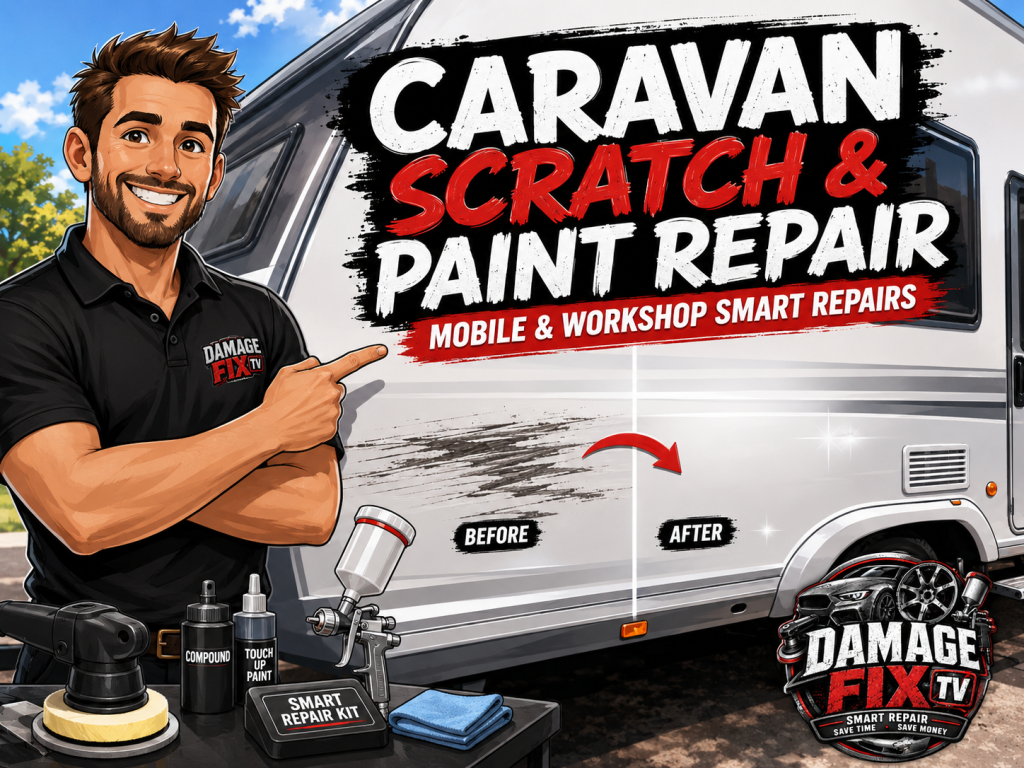
Caravan Scratch & Paint Repair
A scratch along the side of a caravan can be surprisingly difficult to ignore.
You may have driven hundreds of miles through narrow lanes, negotiated several campsites successfully and positioned the caravan perfectly—only for one ambitious branch, gatepost or awning pole to leave its signature down the side.
Some caravan scratches are little more than surface marks that can be polished away. Others cut through paint, coatings, graphics or gelcoat and require a professional local repair.
The difficulty is working out which type you have before reaching for a polishing machine, touch-up pen or mysterious bottle found at the back of the garage.
Damage Fix helps caravan owners understand their repair options and request quotations from suitable mobile and workshop-based caravan scratch and paint repair specialists.
Need a caravan scratch repair quotation?
Upload clear photographs, tell us where the caravan is located and explain how the damage occurred.
Upload Photos and Request Caravan Scratch Repair Quotes
Photograph-based estimates may be provisional. The final price and repair method can change if inspection reveals deeper panel damage, punctures, damaged graphics or previous repairs.
For wide, close and angled image guidance that avoids glare on glossy white panels, read How to Photograph Caravan & Motorhome Damage for a Repair Quote.
Can Caravan Scratches Be Repaired?
Many caravan scratches can be repaired successfully.
The correct method depends on how deeply the damage has penetrated and what the surface is made from.
A caravan exterior may include:
- Painted textured aluminium
- Smooth painted aluminium
- GRP or fibreglass
- Gelcoat
- Painted plastic mouldings
- Decals and printed graphics
- Powder-coated or coated trims
- Acrylic windows
- Unpainted plastic sections
A light surface mark may respond to polishing.
A deeper scratch may require:
- Cleaning and decontamination
- Sanding
- Filling
- Priming
- Colour matching
- Local paint application
- Clearcoat
- Texture reproduction
- Decal replacement
If the scratch has torn the outer skin, cracked the panel or exposed insulation, it is no longer merely a paint repair.
That may sound obvious, but close-up photographs have a habit of making a puncture look like a scratch and a scratch look like a geological event.
What Causes Caravan Scratches and Paint Damage?
Common causes include:
- Trees and hedges
- Narrow driveways
- Storage compounds
- Gateposts
- Fences and walls
- Awning poles
- Loose straps
- Cleaning brushes
- Pressure washers used too closely
- Tools leaning against the caravan
- Road debris
- Bicycle handlebars
- Shopping trolleys
- Contact with another vehicle
- Removing old graphics
- Poor previous repairs
The cause provides useful information about the likely depth.
A branch may leave a long surface mark. A metal gate can create a deeper abrasion, dent or puncture. Contact with another vehicle may add paint transfer and panel distortion.
When requesting a quotation, explain what caused the damage rather than simply writing “scratch”.
The repairer may assess a hedge mark very differently from damage caused by reversing along a brick wall.
Is It a Scratch, Scuff or Abrasion?
These terms are often used interchangeably, but they can describe different types of damage.
Surface marks
A surface mark may sit on top of the caravan finish rather than cutting into it.
Examples include:
- Rubber transfer
- Paint from another object
- Light branch marks
- Cleaning-product residue
- Adhesive marks
- Black scuffing
Some may improve considerably through careful cleaning and polishing.
Scratches
A scratch is a narrower line cut into or through the surface.
It may affect:
- Clearcoat
- Paint
- Gelcoat
- Primer
- Aluminium coating
- A graphic or decal
Abrasions
An abrasion usually affects a wider area.
It may be caused by the caravan rubbing against:
- A wall
- A branch
- A gate
- Another vehicle
- Storage equipment
Abrasions can flatten textured aluminium, remove paint and damage graphics across a larger section.
Gouges
A gouge is deeper and may remove material.
It can require:
- Filling
- Reshaping
- Reinforcement
- Priming
- Refinishing
A gouge in GRP or plastic should be checked for cracking beneath the visible surface.
How Deep Is the Scratch?
The depth of the scratch largely determines the repair.
Light surface scratches
These affect only the upper surface and may not catch a fingernail.
They may respond to:
- Specialist cleaning
- Machine polishing
- Fine abrasive correction
- Surface refinishing
Care must be taken because caravan coatings can be thinner or different from conventional automotive paint.
Scratches through the paint
These may reveal:
- Primer
- Aluminium
- GRP
- Plastic
- A lighter or darker layer beneath
They normally require a local paint repair rather than polishing alone.
Deep scratches and gouges
These may involve:
- Missing surface material
- Sharp edges
- Exposed substrate
- Cracking
- Panel distortion
- Water-ingress risk
The repairer may need to fill and rebuild the damaged area before painting.
Scratches with dents
A scratch may be accompanied by a depression or crease.
In that case, the panel shape should be restored before the visible finish is repaired.
Read our Caravan and Motorhome Dent Repair Guide.
Scratches with punctures
Where the outer skin has split or opened, the repair should address the panel construction and possible moisture entry.
Read our Caravan and Motorhome Panel Repair Guide.
Caravan Paint Repair
A caravan paint repair aims to restore the damaged finish without repainting a much larger area unnecessarily.
Depending on the panel and scratch, the process may include:
- Inspecting the material and damage
- Cleaning and removing contamination
- Removing paint transfer
- Sanding damaged edges
- Filling deeper areas
- Reproducing texture where required
- Applying primer
- Colour matching
- Applying paint
- Blending the repair
- Applying clearcoat or the appropriate finish
- Polishing after curing
- Replacing graphics where necessary
The exact method depends on whether the original surface is automotive paint, gelcoat, coated aluminium or another finish.
A professional repair should also consider how the new finish will look beside the surrounding aged surface.
Paint Matching on Older Caravans
Caravan paint and coatings change over time.
Sunlight, weather, cleaning products and polishing can gradually alter:
- Colour
- Gloss
- Surface texture
- Clarity
- Reflectivity
The original paint code may provide a starting point, but it does not always match the caravan as it appears today.
A repairer may need to adjust the colour to match:
- Faded white panels
- Cream or ivory finishes
- Aged gelcoat
- Previously painted sections
- Different materials on the same caravan
Matching white can be particularly deceptive.
There are many shades of white, including blue white, grey white, cream white and the popular older-caravan shade known informally as “white, but not quite as white as it used to be”.
The objective is to match the surrounding caravan, not merely the colour printed on the original specification sheet.
Textured Aluminium Scratch Repair
Textured aluminium presents an additional challenge because the surface pattern can be damaged alongside the paint.
A scratch or abrasion may:
- Remove the top coating
- Flatten the embossed texture
- Tear raised areas
- Expose bare aluminium
- Damage decals
- Create a shallow dent
Light scratches on textured panels
Very light marks may sometimes be improved without disturbing the texture.
The repairer may use:
- Careful cleaning
- Fine polishing
- Local touch-in work
- Controlled surface correction
Aggressive sanding can flatten the pattern and make the repair more visible.
Deeper scratches and abrasions
Where the texture has been damaged, the repair may require:
- Surface rebuilding
- Texture reproduction
- Primer
- Paint
- Blending
The texture must remain convincing under changing light.
A repair that looks excellent when viewed directly may appear more obvious when the sun travels along the panel at an angle.
Can textured aluminium be perfectly matched?
Some specialists can achieve extremely good results, but the outcome depends on:
- Pattern design
- Damage size
- Depth
- Panel age
- Colour fade
- Repair position
- Viewing angle
The repairer should explain realistic expectations before work begins.
Read our Caravan SMART Repairs Guide.
Smooth Aluminium Caravan Paint Repairs
Smooth aluminium panels may appear easier to repair because there is no embossed texture.
However, smooth sides are excellent at revealing:
- Ripples
- Poor sanding
- Uneven filler
- Colour mismatch
- Incorrect gloss
- Paint edges
The repair must restore both the surface shape and finish.
Where a scratch has caused the aluminium to crease or stretch, conventional paint repair alone will not be enough.
The panel may require reshaping and stabilisation before refinishing.
GRP and Gelcoat Scratch Repair
Some caravans use GRP or fibreglass exterior panels with a gelcoat or painted finish.
GRP damage may include:
- Surface scratches
- Chipped gelcoat
- Gouges
- Star cracks
- Exposed fibres
- Impact damage
- Cracks beneath a scratch
Light gelcoat scratches
Fine surface scratches may respond to:
- Wet sanding
- Compound polishing
- Surface restoration
This work should be completed carefully to avoid thinning the gelcoat excessively.
Deeper gelcoat damage
A deeper repair may involve:
- Removing loose material
- Filling the gouge
- Restoring the shape
- Matching the gelcoat colour
- Sanding and polishing
- Applying paint where appropriate
Exposed fibres
If glass fibres are visible, the damage has penetrated the outer finish.
The repair may require proper GRP reconstruction rather than a cosmetic touch-up.
Read our Motorhome GRP and Fibreglass Repair Guide for a fuller explanation of GRP repair principles.
Caravan Decal and Graphic Damage
Caravan scratches often pass through decals and decorative graphics.
These may include:
- Manufacturer logos
- Model names
- Side stripes
- Printed patterns
- Colour blocks
- Decorative sweeps
A body repair may look unfinished if the panel is restored but the graphic remains torn or incomplete.
Can damaged caravan decals be replaced?
Often, yes.
Options include:
- Replacing the affected section
- Reproducing a discontinued graphic
- Replacing a complete stripe
- Renewing several faded graphics
- Removing the graphic entirely
- Creating a simplified replacement design
Why decal matching can be difficult
Older graphics may have:
- Faded
- Shrunk
- Cracked
- Changed colour
- Become unavailable
- Been replaced previously
A new decal may appear much brighter than the surrounding original graphics.
The repairer may recommend replacing a larger section to create a consistent appearance.
Removing decals
Decal removal can reveal paint that has been protected from sunlight.
The exposed area may look noticeably brighter than the surrounding panel.
This should be considered before changing or removing large graphics.
The quotation should state clearly whether decal replacement is included.
Scratches Around Windows, Doors and Lockers
Damage near an opening should be checked carefully.
A scratch beside a:
- Window frame
- Habitation door
- Locker door
- Service hatch
- Awning rail
- Grab handle
may also involve:
- Seal damage
- Frame distortion
- Loose fittings
- Opened joints
- Water-ingress risk
The visible paint damage may be the least important part.
A repairer should ensure that doors and lockers still:
- Open correctly
- Close evenly
- Lock securely
- Seal against water
Painting over a damaged joint without checking the seal may improve the appearance while leaving the more expensive problem untouched.
Can Caravan Scratches Cause Water Ingress?
A light surface scratch will not normally create water ingress.
A deeper gouge, puncture or open seam may.
Water-entry risk is higher where damage:
- Breaks the outer skin
- Reaches a seam
- Affects an awning rail
- Damages a window frame
- Pulls out a fitting
- Cracks GRP
- Exposes insulation
Signs of possible moisture entry include:
- Damp smells
- Interior staining
- Soft wallboard
- Bubbling surfaces
- Swelling
- Discoloured sealant
If the exterior has been opened, protect the area from rain and arrange an assessment promptly.
Read Can Caravan Body Damage Cause Water Ingress?.
Caravan Scratch Repair at Home
Many localised caravan scratch and paint repairs can be completed by a mobile specialist.
Possible repair locations include:
- Your home
- A private driveway
- A storage facility
- A caravan dealership
- A holiday park
- A campsite, with permission
Mobile repair may be suitable where:
- Damage is localised
- Access is good
- The caravan is parked safely
- Weather conditions are suitable
- Overspray can be controlled
- Limited dismantling is required
- The repair does not involve extensive panel damage
What does a mobile repairer need?
The location may need:
- Off-road parking
- Safe working space
- Firm, level ground
- Electricity
- Suitable lighting
- Shelter
- Distance from neighbouring vehicles
- Permission for sanding and painting
Provide wide photographs of the caravan’s parking position when requesting a quote.
The technician needs enough room to work, not merely enough room to admire the scratch from a distance.
Read our Mobile Caravan and Motorhome Repairs Guide.
Paint and Overspray Considerations
Local paint repair must be completed with appropriate control of:
- Overspray
- Dust
- Wind
- Insects
- Moisture
- Temperature
- Contamination
Nearby vehicles, houses and windows must be protected.
Outdoor spraying may be unsuitable where:
- Caravans are parked closely together
- The area is windy
- Public access is nearby
- Site rules prohibit painting
- The paint area is large
- Weather is unstable
- Controlled blending is required
Professional mobile repairers may use:
- Specialist masking
- Low-overspray equipment
- Portable shelters
- Extraction
- Controlled spray techniques
A still, dry morning can provide suitable conditions for some local repairs.
A windy afternoon involving leaves, dust and an enthusiastic collection of insects is less cooperative.
Weather Limitations
Mobile caravan paint repair is affected by weather.
Rain
Rain can contaminate prepared surfaces and affect coatings, primers and paint.
Wind
Wind carries dust and overspray and can ruin a fresh finish.
Low temperatures
Cold conditions can slow:
- Paint drying
- Adhesive curing
- Filler hardening
- Clearcoat curing
High temperatures
Direct sunlight can make a white caravan panel much hotter than the surrounding air.
Excessive panel temperature can affect paint application and colour matching.
Humidity
High humidity may influence adhesion, drying and final finish.
A repairer may postpone work or recommend workshop conditions if the weather is unsuitable.
This is not unnecessary caution. Paint rarely improves when applied during sideways rain.
When Is Workshop Paint Repair Better?
A specialist workshop may be more suitable where:
- Damage covers a large area
- Several panels are scratched
- Extensive blending is required
- Windows or fittings must be removed
- Several decals need replacing
- GRP reinforcement is necessary
- Water ingress is suspected
- The repair will take several days
- Controlled curing is required
- The caravan must remain dismantled
A workshop provides:
- Dry conditions
- Better lighting
- Temperature control
- Extraction
- Secure dismantling
- Protection from contamination
- Space for larger repairs
Read our Workshop Caravan and Motorhome Repairs Guide.
Polishing or Painting: Which Does the Caravan Need?
This is one of the most common questions.
Polishing may be suitable where:
- The mark is on the surface
- Paint has transferred onto the caravan
- The scratch is extremely light
- The finish remains intact
- The mark does not catch a fingernail
Paint repair may be required where:
- Primer is visible
- Aluminium is exposed
- GRP or plastic is visible
- The scratch catches a fingernail
- Paint has chipped away
- The surrounding coating is cracked
- The damage has been filled previously
Filling and painting may be required where:
- Material is missing
- The panel is gouged
- Texture is damaged
- There is a shallow dent
- The surface has torn
- GRP has chipped
Trying to polish a deep scratch can remove more surrounding finish without eliminating the damage.
If in doubt, send photographs before attacking it with a machine polisher and the confidence of somebody who watched half a video online.
Touch-Up Paint: Useful or Unsightly?
Touch-up paint may help protect a tiny exposed area, but it is not always a complete cosmetic repair.
It can be useful for:
- Small chips
- Tiny exposed spots
- Temporary protection
- Areas where appearance is less critical
It is less successful for:
- Long scratches
- Wide abrasions
- Metallic finishes
- Faded panels
- Textured surfaces
- Damage crossing graphics
Problems can include:
- Incorrect colour
- Thick ridges
- Brush marks
- Poor adhesion
- Trapped contamination
- Paint sitting above the surrounding surface
A touch-up line along a metre-long scratch may protect the panel but can leave it resembling a relief map.
Common DIY Scratch Repair Problems
Some owners achieve reasonable results on tiny marks, but unsuitable products can make professional repair more difficult.
Common problems include:
- Aggressive machine polishing
- Excessive sanding
- Incorrect touch-up paint
- Household gloss paint
- Silicone contamination
- Wax applied before repair
- Unidentified online repair products
- Thick brush marks
- Filler applied over loose paint
- Clearcoat sprayed without preparation
- Pressure washing damaged edges
Silicone and polish residues can cause paint defects and adhesion problems.
Tell the repairer what products have already been applied.
There is no shame in admitting that the scratch has received three coats of touch-up paint and an optimistic layer of clear nail varnish. It is simply useful information.
Removing Paint Transfer
Contact with a gate, wall or another vehicle may leave foreign paint on the caravan.
This can make the damage look worse than it is.
A professional may remove transfer using:
- Specialist cleaners
- Controlled solvents
- Clay or decontamination products
- Fine polishing
Do not use aggressive household solvents without identifying the caravan’s surface.
Some products can soften paint, mark plastics or damage graphics.
Once the transferred material is removed, the underlying scratch can be assessed properly.
Faded and Chalky Caravan Paint
Older caravan finishes may become:
- Dull
- Chalky
- Faded
- Patchy
- Oxidised
Polishing may improve some surfaces, but the correct process depends on whether the panel is painted, gelcoated or coated aluminium.
Aggressive polishing can thin already weathered finishes.
Where a scratch repair is completed on a faded panel, the surrounding area may also need correction so the repaired section does not appear unusually glossy.
A small fresh repair in the centre of a dull panel can otherwise look like the caravan has received one very enthusiastic square of polish.
When Might a Local Scratch Repair Not Be Suitable?
A local SMART repair may not be appropriate where:
- Scratching covers most of the panel
- Several panels are affected
- The panel is badly dented
- The aluminium is torn
- GRP is fractured
- Water ingress is present
- Paint is failing across a large area
- The existing finish is unstable
- The panel is extensively delaminated
- Large graphics must be recreated
- A replacement panel is more economical
A larger workshop repair, full-panel refinishing or panel replacement may provide a more reliable result.
Read When Is a SMART Repair Not Suitable?.
How Much Does Caravan Scratch and Paint Repair Cost?
Prices vary depending on:
- Scratch length
- Scratch depth
- Panel material
- Texture
- Paint type
- Colour matching
- Gelcoat work
- Filling required
- Dents or creases
- Decal replacement
- Mobile travel
- Workshop time
- Previous repairs
- VAT
A light mark that polishes out will cost considerably less than a deep abrasion requiring texture reproduction, paint blending and a replacement graphic.
Why photographs may not reveal the final price
Images may not show:
- Scratch depth
- Panel movement
- Previous filler
- Exposed fibres
- Cracks beneath the paint
- Colour variation
- Silicone contamination
- Damage under decals
A repairer may provide:
- An initial estimate
- A price range
- A provisional quotation
- A quotation subject to inspection
Visit our Caravan Scratch and Paint Repair Cost Guide.
Insurance and Caravan Paint Damage
Scratch and paint damage may be covered by insurance depending on:
- Cause of damage
- Policy terms
- Excess
- Whether another party was involved
- Whether the incident was accidental or malicious
Contact your insurer before authorising work where:
- Damage is extensive
- Several panels are affected
- Another vehicle was involved
- Malicious damage occurred
- Replacement graphics are expensive
- Water ingress is possible
Keep:
- Photographs
- Incident details
- Witness information
- Repair estimates
- Correspondence
For smaller damage, owners may choose to pay privately where the repair cost is close to the policy excess.
Check your own policy before deciding.
How to Photograph Caravan Scratches
Scratches can be difficult to photograph, particularly on white or reflective panels.
Please provide:
- A photograph of the complete caravan side
- A medium-distance image
- A clear close-up
- An angled view along the panel
- Photographs from both directions
- An image showing nearby windows, rails or lockers
- A photograph showing any damaged decal
- An image with a ruler for scale
- A photograph of the interior opposite deep damage
- Wide photographs of the parking area for mobile repair
Soft daylight is often best.
Avoid photographing directly into strong sunlight or using flash straight at a glossy white panel.
A scratch that disappears in the photograph may be excellent news for the camera, but it does not help the repairer prepare an estimate.
Read our Guide to Photographing Caravan and Motorhome Damage.
How the Damage Fix Caravan Scratch Quotation Service Works
1. Tell us about the caravan
Provide:
- Make
- Model
- Approximate year
- Vehicle location
- Towable condition
2. Describe the damage
Explain:
- What caused the scratch
- Which panel is affected
- Approximate length
- Whether the mark catches a fingernail
- Whether bare material is visible
- Whether the panel is dented
- Whether decals are damaged
- Whether a previous repair was attempted
3. Upload photographs
Include wide, medium and close-up images taken from several angles.
4. Select the repair preference
Choose:
- Mobile repair
- Workshop repair
- Either option
- Collection where available
5. Suitable repairers may respond
A repairer may:
- Recommend polishing
- Provide an initial paint-repair estimate
- Request more photographs
- Ask for a short video
- Recommend inspection
- Offer mobile repair
- Recommend workshop refinishing
6. Check the quotation
Confirm whether it includes:
- Cleaning and preparation
- Scratch repair
- Filling
- Texture reproduction
- Primer
- Paint
- Clearcoat
- Blending
- Decal replacement
- Travel
- VAT
- Guarantee
Read How to Choose a SMART Repairer.
Choosing a Caravan Paint Repair Specialist
Ask prospective repairers:
- Have you repaired this type of caravan panel before?
- Is the damage likely to polish out?
- What is the panel made from?
- Does the texture need reproducing?
- How will the paint be matched?
- Will the repair be blended?
- Are decals included?
- Can the work be completed mobile?
- Is the quotation provisional?
- What guarantee is provided?
- Can you show similar repairs?
Relevant leisure-vehicle experience matters.
A technician may be highly skilled at car paintwork but unfamiliar with thin textured aluminium, gelcoat and discontinued caravan graphics.
Frequently Asked Questions
Can caravan scratches be polished out?
Very light surface marks and paint transfer may polish out. Deeper scratches through paint, gelcoat or coating require a more substantial repair.
How can I tell if a scratch is deep?
A scratch that catches a fingernail or exposes a different-coloured layer is unlikely to polish out completely.
Can textured caravan panels be repainted locally?
Yes, but deeper damage may require texture reproduction before painting.
Can a caravan scratch be repaired at home?
Many localised repairs can be completed by a mobile specialist where access, weather and overspray conditions are suitable.
Can damaged caravan decals be replaced?
Many can be replaced or reproduced, although matching faded and discontinued graphics may require a larger section to be renewed.
Can gelcoat scratches be repaired?
Light gelcoat scratches may be sanded and polished. Deeper chips or gouges may need filling and colour-matched refinishing.
Will the repair be invisible?
The aim is to make the repair as unobtrusive as reasonably possible. Texture, colour fade, panel age and graphics can affect the result.
Should I use touch-up paint?
Touch-up paint may protect a tiny exposed area, but it rarely provides an invisible result on a long or deep scratch.
Can scratches cause water ingress?
Surface scratches generally do not. Deep gouges, punctures and damage affecting seams or fittings can allow water into the caravan structure.
Can Damage Fix provide the final price?
Damage Fix helps collect and route quotation enquiries. The repair business is responsible for confirming the method, final price, guarantee and terms.
Request Caravan Scratch and Paint Repair Quotes
A caravan scratch does not necessarily mean that the complete side panel needs repainting or replacing.
Depending on the damage, a specialist may be able to:
- Remove paint transfer
- Polish light marks
- Repair deep scratches
- Rebuild gouged areas
- Reproduce textured finishes
- Match faded paint
- Repair gelcoat
- Replace damaged decals
- Complete the work at home or in storage
Upload photographs, tell us where the caravan is located and explain what caused the damage.
Upload Photos and Request Caravan Scratch Repair Quotes
Damage Fix can then help identify whether the enquiry is better suited to a mobile caravan paint specialist or a workshop-based leisure-vehicle repairer.