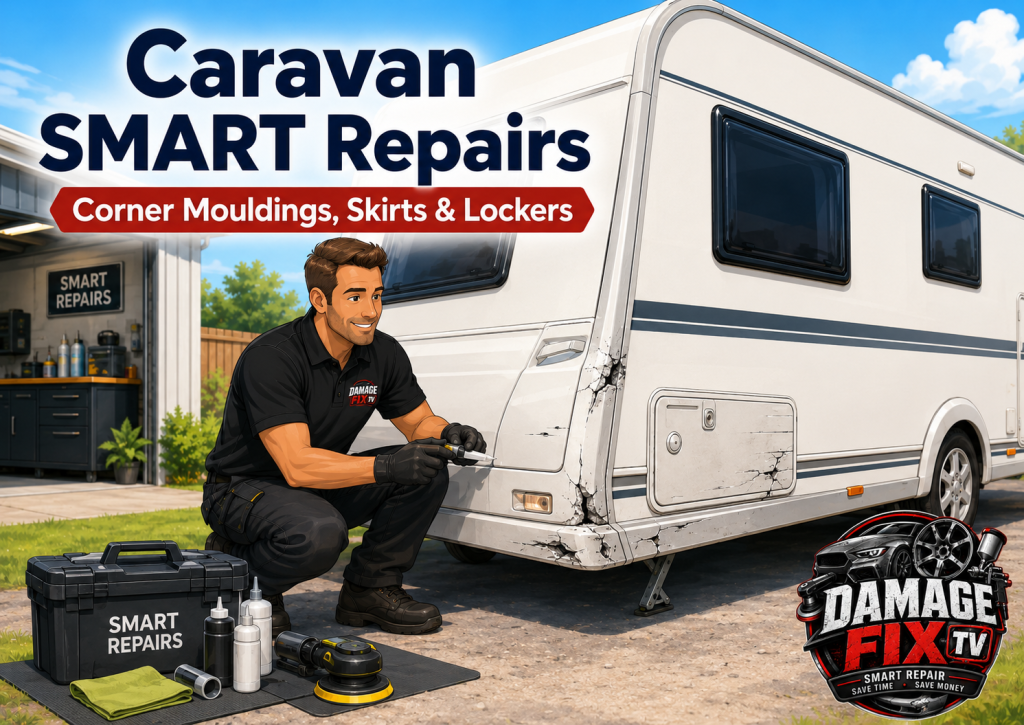
Caravan SMART Repairs
Caravans are built to be light, practical and comfortable.
Unfortunately, this also means they are not especially fond of awning poles, low branches, gateposts, storage-yard walls or reversing manoeuvres carried out with more enthusiasm than visibility.
The good news is that many types of caravan body damage can be repaired without replacing an entire side panel or sending the caravan away for a lengthy rebuild.
Damage Fix helps caravan owners understand their repair options and request quotations from suitable mobile and workshop caravan repair specialists.
Whether your caravan has suffered a small scratch, an awning-pole dent, a cracked corner moulding or a puncture in the side panel, you can upload photographs and provide details of the damage through our quotation service.
Need a caravan repair quotation?
Send clear photographs of the damage, tell us where the caravan is located and explain what happened.
Upload Photos and Request Caravan Repair Quotes
Photograph-based estimates may be provisional. The final repair method and price may change if an inspection reveals hidden damage, water ingress or previous repairs.
What Is a Caravan SMART Repair?
SMART stands for Small to Medium Area Repair Technology.
In simple terms, a caravan SMART repair aims to restore a damaged area without replacing a much larger component unnecessarily.
Depending on the material, position and extent of the damage, a caravan SMART repair may be suitable for:
- Textured aluminium panel damage
- Smooth-sided caravan panels
- Scratches and abrasions
- Small holes and punctures
- Awning-pole damage
- Corner mouldings
- Lower skirts
- External lockers
- Wheel arches
- Plastic trims
- Paint damage
- Decals and graphics
- Interior surfaces
- Shower trays and sinks
- Worktops and furniture
The fact that a damaged area is small does not automatically mean that it is suitable for a small repair.
A shallow dent in the centre of a stable panel may be reasonably straightforward. A similarly sized dent beside a window frame, bonded seam or awning rail may require much more careful assessment.
A good caravan repairer should therefore consider:
- What the panel is made from
- Whether the panel has stretched
- Whether the damage is creased
- Whether the exterior skin has been punctured
- Whether water may have entered
- Whether internal layers are affected
- Whether decals cross the repair
- Whether the repair is better completed mobile or in a workshop
Textured Aluminium Caravan Panel Damage
Textured aluminium has been widely used on caravan side panels for many years.
The embossed finish helps disguise minor marks and gives the panel strength without adding excessive weight. It also creates one of the more difficult surfaces to repair convincingly.
A local repair may involve:
- Stabilising the damaged area
- Reshaping or filling the dent
- Recreating the original texture
- Preparing the surrounding surface
- Applying the correct coating or paint
- Blending the colour and sheen
The challenge is not simply removing the dent.
For a more detailed explanation of panel, rail, sealing and water-ingress considerations, read our Caravan Awning-Pole and Awning-Rail Damage Repair Guide.
The texture must also look consistent when viewed from different angles and in changing light. A repair that looks perfectly respectable in the shade may become more obvious when low sunlight travels along the side of the caravan.
Common textured-panel damage
Typical examples include:
- Awning-pole dents
- Small impact dents
- Shallow creases
- Punctures
- Scratches through the coating
- Damage around handles or rails
- Small holes left by removed fittings
Can every textured panel be repaired?
No.
A repair may be unsuitable where:
- The damage covers a very large area
- The aluminium is severely stretched
- The panel has multiple deep creases
- The damage runs into a bonded seam
- The internal construction has separated
- Water ingress has caused wider deterioration
- The original texture cannot be reproduced acceptably
In some cases, a repair may still improve the damage considerably without making it completely invisible.
That distinction should be explained before work begins. “You probably won’t notice it from the next county” is not a recognised quality standard.
Read more in our Caravan Dent Repair Guide.
Smooth-Sided Caravan Panels
Smooth-sided caravan panels may be manufactured from aluminium, GRP or another composite material.
They often allow a more conventional refinishing process than textured aluminium, but this does not make every repair easy.
The repairer may still need to consider:
- Panel thickness
- Bonded construction
- Access from behind
- Distortion
- Paint or gelcoat finish
- Existing colour fade
- Graphics crossing the damaged area
- Damage near windows and seams
Smooth aluminium panel damage
Smooth aluminium can suffer:
- Dents
- Sharp creases
- Scratches
- Punctures
- Rippling
- Damage around rails and handles
Thin caravan aluminium behaves differently from a steel car door. It may stretch, tear or distort more easily, particularly where it is bonded to insulation or internal wallboard.
GRP caravan panels
Some caravans use GRP or fibreglass panels.
These may suffer:
- Surface cracks
- Impact fractures
- Chipped gelcoat
- Small holes
- Split corners
- Stress cracking
A professional GRP repair may require reinforcement beneath the surface before the visible area is rebuilt and refinished.
Simply applying filler over a moving crack usually creates a short-lived improvement followed by the crack returning for an encore.
Caravan Scratches and Abrasions
Scratches are among the most common caravan repair enquiries.
They can result from:
- Trees and hedges
- Narrow storage access
- Gateposts
- Awning poles
- Cleaning equipment
- Loose straps
- Roadside vegetation
- Accidental contact with tools or furniture
Not every scratch requires paintwork.
Light surface marks
Some light marks may affect only the surface coating and may improve through careful cleaning, polishing or machine correction.
Before polishing, the repairer should confirm that the surface is suitable and that the mark has not cut through the finish.
Deeper scratches
A deeper scratch may pass through:
- Clear coating
- Paint
- Gelcoat
- Primer
- Aluminium coating
- Plastic finish
- A decal or graphic
These may require filling, preparation and local refinishing.
Where the scratch crosses a decal, the graphic may also need to be:
- Replaced
- Reproduced
- Repositioned
- Extended
- Removed and renewed as a larger section
Abrasions
Abrasions are wider scuffed areas, often caused by rubbing against a wall, branch or fixed object.
They may involve:
- Flattened texture
- Exposed material
- Scraped paint
- Damaged graphics
- Distorted mouldings
The repair method depends on how deeply the surface has been affected.
Visit our Caravan Scratch Repair Guide.

Small Holes and Punctures
A small hole in a caravan panel may look alarming, but local repair can sometimes be possible.
Common causes include:
- Awning poles
- Branches
- Reversing impacts
- Tools
- Removed accessories
- Failed fittings
- Sharp objects in storage
- Contact with trailers or other vehicles
The visible hole is only one part of the assessment.
The repairer should consider:
- Whether the exterior skin has torn
- Whether the insulation is damaged
- Whether the inner wallboard is affected
- Whether moisture has entered
- Whether the surrounding panel has stretched
- Whether the puncture is close to a seam
- Whether wiring or internal fittings are nearby
Temporary protection
If the puncture is open to the weather, it may need temporary protection before repair.
However, avoid filling the area with household sealant, expanding foam or a generous collection of mystery adhesives.
These products may complicate the eventual repair and can trap moisture inside the panel.
A temporary waterproof covering should protect the area without making the damage harder to assess.
When a puncture may require workshop attention
A workshop may be more suitable where:
- The hole is large
- Both skins are damaged
- Internal furniture must be removed
- Water has entered
- The panel has delaminated
- The puncture is near a window or structural rail
- The surrounding area is badly distorted
Read our Caravan Panel Repair Guide.
Caravan Awning-Pole Damage
Awning-pole dents deserve a section of their own because they are one of the most familiar forms of caravan body damage.
A pole can cause:
- A shallow dent
- A sharp circular depression
- A crease
- A puncture
- Scratched paint
- Flattened texture
- Damage around an awning rail
The outcome depends on the force of the impact, the panel material and where the pole made contact.
Why awning-pole dents can be difficult
A pole concentrates force into a relatively small area.
Even where the visible dent appears modest, the aluminium may have stretched or creased around the impact point.
If the damage is on textured aluminium, the texture must also be recreated after the shape is restored.
Mobile repair suitability
Many localised awning-pole dents may be suitable for mobile assessment or repair, provided:
- The caravan can be accessed safely
- Weather conditions are suitable
- The damaged area is stable
- The repair does not require major dismantling
- There is no sign of water ingress
Larger creases or damage near rails and windows may need workshop inspection.
Read our guide: Caravan Awning-Pole Dent Repair Options.
Caravan Corner Moulding Repairs
Caravan corner mouldings help finish and protect the body edges.
Depending on the caravan, they may be made from:
- ABS plastic
- GRP
- Thermoplastic
- Composite material
- Painted moulded sections
Common damage includes:
- Cracks
- Scrapes
- Split mounting points
- Missing sections
- Distortion
- Paint damage
- Damage around lights and reflectors
Repair or replace?
Repair may be worthwhile where:
- The component remains mostly complete
- Replacement parts are expensive
- A new part is unavailable
- The material can be bonded or reinforced
- The mounting area can be restored
- A satisfactory cosmetic finish can be achieved
Replacement may be preferable where:
- The component is badly distorted
- Large sections are missing
- The plastic has become extremely brittle
- Mounting areas are extensively damaged
- A replacement is readily available and economical
The visible crack should not be the only focus.
A corner moulding may appear to have minor surface damage while the fixings behind it have torn away.
Visit our Caravan Corner Moulding Repair Guide.
Caravan Lower Skirt Repairs
Lower skirts run along the bottom edge of many caravans and are particularly exposed to damage.
They may be affected by:
- Kerbs
- Levelling ramps
- Storage obstacles
- Road debris
- Towing incidents
- Jacking equipment
- Reversing accidents
- Loose or broken fixings
Common skirt damage includes:
- Cracks
- Scrapes
- Split edges
- Missing pieces
- Pulled fixings
- Paint damage
- Distortion
Can caravan skirts be repaired?
In many cases, yes.
A repair may involve:
- Removing the damaged section
- Restoring the shape
- Reinforcing the reverse side
- Reconstructing missing material
- Repairing mounting points
- Refinishing the visible surface
- Reinstalling the skirt correctly
The exact process depends on the material and whether the skirt can be removed safely.
Where a skirt is still under tension or incorrectly mounted, repairing only the crack may not provide a lasting result.
Read our Caravan Lower Skirt Repair Guide.
Caravan External Locker Repairs
External lockers and access doors are vulnerable to knocks, broken hinges, cracks and impact damage.
Common problems include:
- Cracked locker doors
- Damaged frames
- Broken corners
- Surface scratches
- Distorted doors
- Failed hinges
- Damaged catches
- Water entering around seals
- Cosmetic damage around locks
What should be checked?
Before cosmetic repair, the repairer should confirm:
- The locker opens and closes correctly
- The frame is not distorted
- The seal still makes contact
- Hinges and catches are secure
- Water cannot enter
- The surrounding panel is not damaged
- The lock remains functional
A locker door that looks smart but no longer seals against rain is not a successful repair.
Where parts are obsolete, local repair or reconstruction may be particularly worthwhile.
Visit our Caravan External Locker Repair Guide.
Other Caravan Exterior Repairs
Caravan SMART repair specialists may also be able to help with:
Wheel arches
Wheel arches can crack, split or become damaged around their fixings.
Repairability depends on the plastic type, missing material and condition of the mounting points.
Grab handles and fittings
Damage around grab handles may involve the fitting, mounting points and surrounding panel.
Water ingress is a particular concern if fixings have pulled through the outer skin.
Decals and graphics
Graphics may need replacing after a body repair.
Older decals can be difficult to match because:
- The original design may be discontinued
- Existing graphics may have faded
- Colours may vary between production runs
- Removing old graphics can reveal unfaded paint
A repairer should explain whether the plan is to replace one section or recreate a larger stripe or graphic.
Roof and upper panel damage
Damage on the roof or high-level panels may require specialist access, safe working equipment and workshop facilities.
Possible water ingress should be assessed promptly.
Interior Caravan SMART Repairs
Caravan repairs are not limited to the exterior.
Specialist interior repairs may include:
- Shower trays
- Sinks and washbasins
- Worktops
- Cupboards
- Furniture panels
- Wallboard
- Flooring
- Vinyl
- Plastic trim
- Leather and upholstery
Shower tray repairs
A cracked shower tray may require more than a cosmetic patch.
The tray may need to be stabilised or reinforced so that it does not continue flexing beneath the repair.
Read our Caravan and Motorhome Shower Tray Repair Guide.
Worktop repairs
Burns, chips, impact damage and screw holes may sometimes be repaired locally.
A good repairer will check that the board beneath the laminate is dry and stable.
Furniture repairs
Small chips, missing corners and damaged laminated finishes may be reconstructed and colour matched.
This can be particularly useful where replacement furniture is unavailable or would require substantial dismantling.
Explore Caravan and Motorhome Interior Repairs.
Mobile Caravan SMART Repairs
Many localised caravan repairs can be completed at:
- The owner’s home
- A storage facility
- A dealership
- A campsite, where permitted
- A workshop forecourt
- Another suitable safe location
Mobile repair may be convenient where the caravan is difficult to move or already in storage.
What mobile repairers need
The location should provide:
- Safe access around the damaged area
- Firm, level ground
- Sufficient working space
- Suitable lighting
- Shelter where required
- Permission from the property or site owner
- Access to electricity if requested
Paintwork and repair materials may be affected by cold, rain, wind and humidity.
A repairer may therefore postpone or relocate the work if the conditions are unsuitable.
Read our Mobile Caravan and Motorhome Repair Guide.
Workshop Caravan Repairs
Workshop repair may be more appropriate where the work involves:
- Large panel damage
- Extensive paintwork
- Panel replacement
- Water ingress
- Delamination
- Major dismantling
- Window removal
- Structural assessment
- Extensive puncture damage
- Multiple damaged areas
- Insurance accident repair
- Controlled drying or curing
A workshop offers:
- Protection from weather
- Better lighting
- Specialist extraction and equipment
- Secure dismantling
- Space for longer repairs
- Easier access to both sides of components
Some repairs may begin with photographs and then move to workshop inspection once the likely scope is understood.
Visit our Workshop Caravan and Motorhome Repair Guide.
Is the Damage Suitable for a Caravan SMART Repair?
Damage may be suitable where it is:
- Localised
- Stable
- Accessible
- Cosmetic rather than structural
- Free from serious moisture damage
- Repairable without compromising a seam or joint
- On a material that can be restored reliably
- Economically sensible to repair
Damage that may not be suitable
A local SMART repair may be unsuitable where there is:
- Major structural distortion
- Extensive delamination
- Widespread water ingress
- Severe timber deterioration
- Large-scale hail damage
- Extensive panel stretching
- Serious accident damage
- Chassis damage
- Damage to gas or electrical systems
- An unsafe towing condition
- A component that cannot be repaired reliably
Damage Fix should never try to describe every problem as a SMART repair simply because the phrase is convenient.
Sometimes the correct answer is a workshop repair, full panel replacement or referral to a different specialist.
Read When Is a SMART Repair Not Suitable?.
Caravan Repair Costs
The cost of a caravan SMART repair depends on more than the visible size of the damage.
Important factors include:
- Panel material
- Texture
- Depth of damage
- Creasing
- Stretching
- Paint finish
- Colour matching
- Decals
- Access
- Dismantling
- Mobile travel
- Workshop time
- Previous repair work
- Water ingress
- Replacement parts
- VAT
A small scratch may cost relatively little compared with a puncture involving both the exterior skin and interior wallboard.
Similarly, two dents of the same size may have very different prices if one is on a smooth accessible panel and the other is on textured aluminium beside an awning rail.
Visit our Caravan Body Repair Cost Guide.
Insurance and Private Caravan Repairs
Caravan repairs may be funded privately or through insurance.
Private repairs
Private payment may be suitable where:
- The damage is minor
- The repair cost is near the policy excess
- The owner prefers not to make a small claim
- The caravan remains usable
- The repair can be completed quickly
Insurance claims
Contact your insurer before authorising repairs where:
- The damage is substantial
- Another person or vehicle is involved
- The caravan may be unsafe to tow
- Storm or hail damage is involved
- Theft or malicious damage has occurred
- Recovery is required
- The policy may impose repair conditions
Keep clear photographs, incident details and written quotations.
Visit Caravan and Motorhome Insurance Repairs.
How to Request a Caravan Repair Quote
The Damage Fix quotation process is designed to help suitable repairers understand the damage before contacting you.
1. Provide caravan details
Tell us the:
- Make
- Model
- Approximate year
- Location
- Storage situation
- Towable condition
2. Describe the damage
Explain:
- What happened
- Which area is affected
- Approximate size
- Whether the panel is punctured
- Whether water may be entering
- Whether the damage has changed
- Whether anyone has attempted a repair
3. Upload clear photographs
Include:
- A wide view of the caravan side
- A photograph from around one metre away
- A close-up
- An angled image showing depth
- An interior image where relevant
- A photograph showing nearby rails, windows and decals
4. Select mobile or workshop preference
Choose:
- Mobile repair
- Workshop repair
- Either
- Collection where available
5. Review repairer responses
Check:
- What work is included
- Whether VAT is included
- Whether graphics are included
- Whether the price is provisional
- Timescale
- Guarantee
- Repair location
Read our How to Choose a SMART Repairer Guide.
Frequently Asked Questions
Can a dent in a textured caravan panel be repaired?
Some textured-panel dents can be repaired, but the result depends on the depth, crease, panel stretching and whether the original texture can be reproduced satisfactorily.
Can caravan punctures be repaired?
Small punctures may sometimes be repaired locally. The repairer must check the outer skin, insulation, internal wallboard and possibility of water ingress.
Can a caravan repair be completed at my home?
Many localised repairs can be completed by a mobile repairer if there is safe access, suitable weather and enough working space.
Can awning-pole damage be repaired?
Awning-pole dents and punctures are often repairable, but sharp creases and damage near rails or windows may be more difficult.
Can cracked caravan skirts be repaired?
Many skirts can be bonded, reinforced and refinished. The repairer should also restore any broken mounting points.
Can an external locker door be repaired?
Depending on the material and extent of the damage, locker doors and frames can often be repaired rather than replaced.
Will the repair be invisible?
The aim is to restore the appearance as closely as reasonably possible. Textured panels, faded finishes and discontinued graphics may prevent a completely invisible result.
Do I need a workshop quotation?
Not always. Clear photographs may support an initial estimate, but complex damage may require an in-person inspection.
Can Damage Fix tell me the final repair cost?
Damage Fix helps collect and route quotation enquiries. The repair business is responsible for confirming the repair method, final price and terms.
Request Caravan SMART Repair Quotes
Whether your caravan has a textured-panel dent, smooth-panel scratch, puncture, damaged corner, lower skirt or external locker, the first step is to provide clear information.
Upload photographs, tell us where the caravan is located and explain what happened.
Upload Photos and Request Caravan Repair Quotes
Damage Fix can then help identify whether the enquiry is more likely to suit a mobile caravan SMART repairer or a specialist workshop.