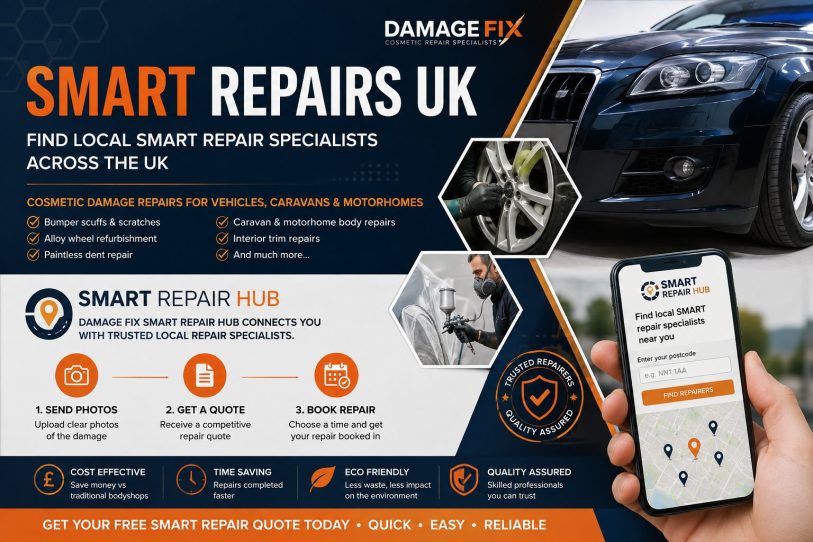
A scraped bumper, kerbed alloy wheel or mysterious car park dent can be surprisingly irritating.
The damage may only cover a few centimetres, yet once you have noticed it, your eyes seem magnetically drawn towards it every time you approach the vehicle. Friends may insist they cannot see it, but you can—and that is usually enough.
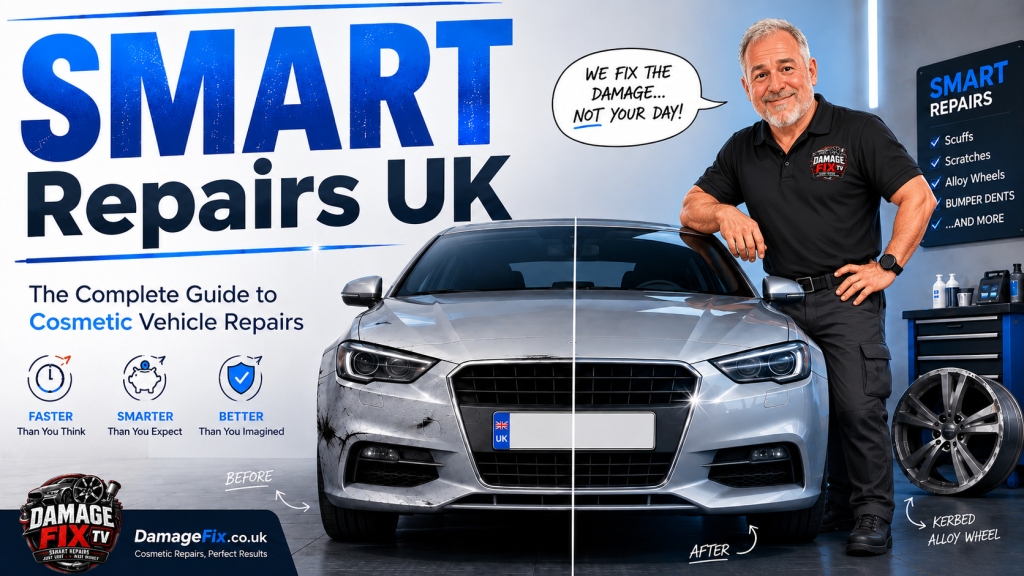
Fortunately, many smaller areas of cosmetic vehicle damage can be repaired without replacing entire panels or repainting half the car. This is where SMART repair comes in.
SMART repairs are widely used throughout the UK for bumper scuffs, paint scratches, alloy wheel damage, minor dents, paint chips, interior trim damage and several types of caravan and motorhome damage.
However, SMART repair is not a magic phrase that makes every form of vehicle damage cheap, quick or invisible. Some repairs are ideal for localised techniques. Others are better handled by a traditional bodyshop, specialist workshop or replacement part.
This guide explains what SMART repair is, which types of damage may be suitable, how the repair process works, what affects the price and how to choose a repairer with confidence.

What Is a SMART Repair?
SMART is commonly understood to mean Small to Medium Area Repair Technology or Small to Medium Area Repair Techniques.
In practical terms, it refers to methods used to repair a relatively localised area of vehicle damage without automatically replacing or refinishing a much larger section than necessary.
For example, a scuff on the corner of a painted bumper may be repairable without removing and repainting the whole bumper. A small scratch may be blended into part of a panel rather than refinishing an entire side of the vehicle. A kerbed alloy wheel may be cosmetically restored instead of replaced.
The important word is localised.
A proper SMART repair concentrates on the damaged area while still allowing enough room for preparation, colour matching, paint blending and finishing. It does not simply mean dabbing paint directly over the mark and hoping nobody looks too closely.
SMART repair can include:
- Paintwork repairs
- Plastic bumper repairs
- Alloy wheel refurbishment
- Paintless dent removal
- Paint chip repairs
- Interior trim repairs
- Leather and vinyl repairs
- Caravan and motorhome cosmetic repairs
- Lease return damage repairs
Different repairers may specialise in different areas. Someone who produces excellent bumper paintwork may not necessarily repair diamond-cut alloy wheels, leather seats or motorhome panels.
That is perfectly normal. SMART repair is a broad category rather than one single skill.
What Types of Damage Can Be SMART Repaired?
Suitability depends on the size, position and severity of the damage, along with the material, vehicle colour and condition of the surrounding area.
The following are some of the most common SMART repair services available across the UK.
Bumper Scuff Repairs
Painted plastic bumpers are particularly vulnerable to car park pillars, garden walls, shopping trolleys and other vehicles whose drivers apparently did not leave a forwarding address.
Typical bumper damage includes:
- Surface scuffs
- Paint transfer
- Scratches
- Small gouges
- Localised paint loss
- Minor plastic distortion
- Small cracks or splits
- Damage around bumper corners
Many bumper corner scuffs are well suited to SMART repair because the damage is contained within a relatively small area.
However, appearances can be misleading.
In my experience, customers often describe bumper damage as “just a scuff”, but photographs can hide distortion, cracked mounting points and previous repairs. A good repairer will check the shape of the bumper and the condition of the plastic before giving a final price.
A dark mark may simply be paint transferred from another object. Alternatively, what looks like a light scrape may have cut deeply into the plastic.
Previous repair material can also affect the job. If an old layer of filler or paint begins lifting during preparation, the repair area may need to be extended.
When might a bumper need more than SMART repair?
A larger bodyshop repair or replacement may be preferable when:
- The bumper is badly split
- Mounting brackets are broken
- The plastic is heavily distorted
- Damage extends across a large area
- Parking sensors or safety equipment are affected
- Several previous repairs are failing
- The bumper is no longer securely fitted
A competent repairer should be willing to say when a localised repair is not the best option.
Car Scratch Repairs
The word “scratch” covers everything from a faint surface mark to a deep line through several layers of paint.
Common types include:
- Clear-coat scratches
- Scratches through the colour coat
- Deep scratches exposing primer
- Scratches exposing bare metal or plastic
- Key scratches
- Branch and hedge marks
- Paint transfer
- Scratches crossing more than one panel
A light scratch within the clear coat may be removable or significantly improved through machine polishing. Deeper damage generally requires paintwork.
A useful first check is to clean the area properly. Dirt and transferred paint can make the damage appear worse than it is.
Avoid attacking it immediately with an abrasive household product. Toothpaste belongs in the bathroom, not in a professional paint system.
Can every scratch be repaired locally?
No.
A short scratch in a suitable position may be ideal for SMART repair. A long scratch running across two doors and a rear quarter panel is a very different job.
The repairer must consider:
- Scratch depth
- Length
- Panel position
- Paint colour
- Existing paint condition
- Nearby edges and body lines
- Whether bare metal is exposed
- Whether the damage crosses multiple panels
Metallic and pearlescent colours can require more blending space than customers expect. The visible scratch may be narrow, but the working repair area will normally be larger.
Read more: Car Scratch Repair Guide
Paint Chip Repairs
Paint chips commonly appear on:
- Bonnet leading edges
- Front bumpers
- Door edges
- Wheel arches
- Sills
- Lower body panels
- Areas struck by stones or road debris
A small isolated chip may be suitable for a touch-in repair, especially where the main aim is protection rather than a completely invisible finish.
Larger chips, clusters of stone chips or damage in highly visible areas may require refinishing.
Touch-up paint can improve the appearance and help protect exposed material, but it should not be confused with a fully prepared and refinished paint repair.
The desired result matters.
A customer preparing an older everyday vehicle for winter may be satisfied with a careful protective touch-in. Someone preparing a prestige car for sale may expect a much more refined finish.
Neither expectation is necessarily wrong, but the repairer and customer should agree on it before work begins.
Alloy Wheel Repairs
Kerbed alloy wheels are among the most common cosmetic vehicle repairs.
Damage can include:
- Kerb rash
- Scratches
- Paint loss
- Corrosion
- Lacquer failure
- Discolouration
- Small chips
- Damage around the wheel rim
Before quoting, the repairer needs to identify the wheel finish.
Common finishes include:
- Standard painted alloy wheels
- Powder-coated wheels
- Diamond-cut wheels
- Polished wheels
- Two-tone wheels
- Specialist manufacturer finishes
A painted alloy wheel may be suitable for a mobile cosmetic repair. A diamond-cut wheel usually requires specialist equipment to reproduce the machined finish correctly.
Structural concerns are separate from cosmetic appearance.
A wheel that is cracked, buckled, badly corroded or losing air needs proper assessment. Making a damaged wheel look attractive does not automatically make it safe.
An industry observation
Customers sometimes send a close-up photograph of a wheel and ask for a definite price without mentioning that the tyre is damaged, the rim is distorted or the wheel has already been repaired three times.
A useful quotation photograph should show the entire wheel as well as the damaged section.
Read more: Alloy Wheel Repair Guide
Minor Dent Repairs and Paintless Dent Removal
Paintless dent removal, commonly shortened to PDR, can sometimes reshape a dent without repainting the panel.
It may be suitable when:
- The paint is still intact
- The dent is accessible
- The metal is not excessively stretched
- The damage is away from difficult reinforced areas
- The panel edge is not severely distorted
Typical PDR candidates include:
- Small car park dents
- Door dings
- Minor panel impressions
- Some hail damage
- Shallow dents without paint damage
PDR is a skilled process. The technician gradually manipulates the metal using specialist tools and lighting.
It is not simply a case of pushing the dent from behind until it “pops out”. That approach can produce high spots, cracked paint and a panel that resembles a badly made pie lid.
Some dents cannot be repaired using PDR because of their position, depth, sharpness or lack of access. Where the paint has already cracked, conventional body and paint repair may be necessary.
Read more: Dent Repair and PDR Guide
Interior Trim Repairs
SMART techniques are also used inside vehicles.
Repairable interior damage may include:
- Scratched plastic trim
- Scuffed door cards
- Dashboard marks
- Worn steering wheels
- Minor leather seat damage
- Vinyl damage
- Small burns
- Colour loss
- Cracked or worn bolsters
Interior repair quality depends heavily on colour matching, texture reproduction and preparation.
A repair may restore appearance very effectively, but customers should have realistic expectations. Deeply torn material, badly collapsed seat foam or large areas of deterioration may require retrimming or replacement.
Cleaning is also important. Some “damage” is actually dye transfer, ingrained dirt or product residue.
A professional assessment can prevent an unnecessary repair.
Lease Car Return Damage
SMART repair is often considered before returning a lease or finance vehicle.
Common concerns include:
- Kerbed alloy wheels
- Bumper scuffs
- Scratches
- Minor dents
- Paint chips
- Interior marks
- Damaged trim
Before arranging repairs, check the leasing company’s current fair wear and tear standards. Not every mark will necessarily result in a charge.
The decision should be based on:
- Severity of the damage
- Likely return charge
- Cost of repair
- Quality of the proposed repair
- Time remaining before inspection
Do not leave the inspection until the evening before collection and then expect every local repairer to reorganise their week around your bumper.
Ideally, inspect the vehicle several weeks before return. Clean it first and examine it in good daylight.
Read more: [Lease Car Return Damage Guide]
Caravan and Motorhome SMART Repairs
Caravans and motorhomes bring their own repair challenges.
Their construction may involve:
- Aluminium skins
- GRP or fibreglass panels
- Textured panels
- Plastic mouldings
- Decals and graphics
- Specialist paint finishes
- Composite materials
Common cosmetic damage includes:
- Corner scrapes
- Body panel scratches
- Cracked plastic trim
- Damaged skirts
- Small holes
- Awning damage
- Shower tray cracks
- Interior surface damage
- Minor impact damage
These repairs should be assessed by someone familiar with leisure vehicle construction.
A repair method suitable for a steel car panel may not be appropriate for a thin caravan skin or textured GRP surface.
Water ingress is especially important. Damage around joints, seals, windows, rooflines or structural sections may require more than a cosmetic repair.
Read more:
- [Caravan SMART Repair Guide]
- [Motorhome Body Repair Guide]
- [Caravan and Motorhome Shower Tray Repair Guide]
How Does a SMART Repair Work?
The exact process varies, but a professional paint repair will normally involve several stages.
1. Damage assessment
The repairer checks:
- The type of damage
- The affected material
- The stability of the panel or plastic
- Previous repair work
- Paint condition
- Colour and finish
- Access
- Nearby trim, sensors and edges
Photographs are useful for an initial estimate, but they do not reveal everything.
Lighting, camera angle, water on the panel and reflections can all disguise damage.
2. Cleaning and preparation
The area must be cleaned and decontaminated.
Silicone, wax, road film, polish and other residues can interfere with paint adhesion. This is why preparation often takes longer than customers imagine.
The visible act of spraying paint may only occupy a small part of the job. Much of the skill lies in what happens before and after.
3. Sanding and shaping
Damaged paint is feathered back to create a stable repair edge.
Gouges, chips or surface defects may require filling and shaping. Plastic damage may need specialist repair material.
The aim is to restore the surface and remove unstable edges without creating unnecessary damage around it.
4. Priming
Primer may be applied where required to:
- Protect exposed material
- Support adhesion
- Fill fine preparation marks
- Create a consistent base for colour
Primer must then be prepared correctly before colour application.
5. Colour matching
Modern vehicle colour matching involves more than reading the paint code.
The code identifies the original colour family, but variations can occur because of:
- Factory production differences
- Vehicle age
- Sun exposure
- Previous paintwork
- Application method
- Panel orientation
- Metallic flake behaviour
A repairer may use colour chips, spectrophotometer readings, tinting knowledge or test cards to obtain a suitable match.
6. Paint application and blending
Colour is applied to the repair area and blended where necessary.
Clear coat is then applied according to the paint system and repair method.
The repairer must manage:
- Coverage
- Colour transition
- Metallic orientation
- Overspray control
- Panel edges
- Drying conditions
- Final finish
7. Curing and finishing
Paint must be allowed or encouraged to cure correctly.
The repaired area may then be polished to refine the finish and remove minor surface imperfections.
Customers should receive sensible aftercare advice, especially regarding washing, polishing and exposure to harsh chemicals.
Mobile SMART Repair or Workshop Repair?
Both mobile and workshop-based repairs can produce excellent results.
The right option depends on the job.
Mobile SMART repair may be suitable for:
- Localised bumper scuffs
- Small paint repairs
- Painted alloy wheel damage
- Minor scratches
- Certain dents
- Convenient repairs at home or work
Workshop repair may be preferable for:
- Larger repairs
- Multiple panels
- Specialist wheel finishes
- Extensive preparation
- Poor weather conditions
- Complex colour matching
- Repairs requiring panel removal
- Caravan or motorhome work needing specialist facilities
Mobile repairers need a safe and suitable working area.
That generally means enough space, access to the vehicle and protection from unsuitable weather. A narrow road beside moving traffic is not a mobile bodyshop, regardless of how optimistic everyone feels.
Some mobile technicians use enclosed structures or controlled mobile units. Others may postpone paintwork when temperature, wind, rain or contamination risks make the job unsuitable.
That is normally a sign of professionalism rather than inconvenience.
Are SMART Repairs Permanent?
A correctly completed SMART repair should be durable.
Longevity depends on:
- Preparation quality
- Material compatibility
- Paint system
- Application method
- Curing
- Environmental conditions
- Previous repairs
- Ongoing vehicle care
Poor preparation is one of the main reasons cosmetic repairs fail.
Possible signs of a failing repair include:
- Peeling lacquer
- Shrinkage
- Sink marks
- Visible sanding scratches
- Poor colour match
- Overspray
- Blistering
- Cracking
- Repair edges becoming visible
A low price does not automatically mean poor quality, and a high price does not guarantee perfection. However, quotations that appear unusually cheap may leave little time for proper preparation and finishing.
Ask what the repair involves rather than comparing prices alone.
When Is SMART Repair Not Suitable?
SMART repair is not always the right answer.
A larger repair, replacement component or specialist assessment may be needed when:
- Damage is structural
- Safety systems are affected
- A wheel is cracked or badly distorted
- Corrosion is extensive
- Paint damage covers a large area
- Several panels are involved
- The panel is severely creased
- Bumper mounts are broken
- Damage has caused water ingress
- Previous repairs are unstable
- The customer expects a result beyond what a localised method can reasonably provide
One of the most useful things an experienced repairer can say is:
“This is not the right type of repair for this damage.”
A repairer who accepts every job without discussing limitations may be more interested in today’s invoice than tomorrow’s finish.
Read more: [When Is a SMART Repair Not Suitable?]
How Much Does a SMART Repair Cost in the UK?
There is no single SMART repair price.
A quotation may be affected by:
- Type of repair
- Damage size
- Damage depth
- Vehicle make and model
- Paint colour
- Panel material
- Wheel finish
- Repair location
- Access
- Previous repairs
- Mobile or workshop service
- Number of damaged areas
- Local operating costs
- Required finish
Two marks of apparently similar size may need very different repair processes.
For example, a superficial black paint transfer on a bumper may polish away. A similarly sized mark nearby could be a deep gouge requiring plastic preparation, primer, colour and clear coat.
This is why photographs should be used for preliminary estimates rather than treated as a legally binding diagnosis delivered by smartphone.
DamageFix publishes separate cost guides covering individual services:
- [Bumper Repair Cost UK]
- [Car Scratch Repair Cost UK]
- [Alloy Wheel Repair Cost UK]
- [Dent Repair Cost UK]
How to Get an Accurate SMART Repair Quote
Good photographs make quotations easier.
Send:
- A photograph showing the whole panel or wheel
- A medium-distance photograph showing the damage position
- A close-up showing detail
- Additional angles to reveal distortion
- The vehicle make, model, year and colour
- A description of how the damage occurred
- Your location
- Details of any previous repair in the same area
Take photographs in daylight where possible.
Avoid:
- Heavy shadows
- Reflections hiding the damage
- Photographs taken in darkness
- Images covered in rainwater
- Extreme close-ups with no context
- Screenshots of another photograph
- Sending only the least damaged angle
Repairers know that damage does not become cheaper because one photograph carefully excludes half of it.
For some jobs, a final quotation will only be possible after inspection.

How to Choose a SMART Repairer
A good repairer should be willing to explain:
- What repair method is proposed
- Which area will be repaired
- Whether the damage has limitations
- Whether parts need removing
- How colour matching will be approached
- How long the job may take
- What aftercare is required
- What guarantee or support is offered
Look for:
- Genuine before-and-after photographs
- Clear contact information
- Real customer feedback
- Professional communication
- Relevant experience
- Sensible expectations
- Clean working practices
- Appropriate insurance
- A written quotation where practical
Be cautious when:
- Every repair is described as “easy”
- A quotation is given without seeing useful photographs
- The repairer avoids discussing previous damage
- There is no explanation of the process
- The price changes repeatedly without reason
- Full payment is demanded through an unusual method
- Images appear copied from other businesses
- The promise sounds too good to be true
A professional repairer does not need to blind customers with technical language. They should be able to explain the job in ordinary English.
Read more: [How to Choose a SMART Repairer]
Common SMART Repair Myths
“SMART repairs never last”
A properly prepared and correctly applied repair should be durable.
Failures are more likely to result from poor preparation, incompatible materials, rushed curing or unstable previous repairs than from the repair simply being labelled SMART.
“The whole panel always needs painting”
Sometimes it does. Often it does not.
The correct approach depends on the colour, damage position, paint system and desired result.
“Any scratch can be polished out”
Polishing removes or refines a small amount of the upper paint surface. It cannot replace colour that is no longer present.
If the scratch has passed through the clear coat and colour layer, polishing alone will not restore it.
“A mobile repair must be lower quality”
Not necessarily.
Many mobile technicians produce excellent work. The deciding factors are experience, process, materials, working conditions and repair suitability.
“A tiny mark should only take a few minutes”
The size of the mark is not the same as the amount of work involved.
Preparation, masking, mixing, colour matching, drying and finishing still need to happen. A small repair may require considerable care precisely because the surrounding area is not being refinished.
“All alloy wheels are repaired in the same way”
They are not.
Painted, powder-coated, polished and diamond-cut wheels may require different equipment and processes.
Are SMART Repairs Better for the Environment?
A suitable localised repair may use fewer materials and avoid replacing an otherwise serviceable component.
Potential benefits can include:
- Less paint and consumable use
- Fewer replacement parts
- Reduced waste
- Shorter repair processes
- Extending the life of existing components
- Mobile service reducing some customer travel
However, environmental claims should remain sensible.
Materials still need to be used, controlled and disposed of properly. Paint products and solvents require responsible handling. A poor repair that has to be completed twice is not especially efficient.
The most sustainable repair is usually one that is appropriate, durable and carried out correctly the first time.
SMART Repairs for Cars, Vans and Commercial Vehicles
Although car damage receives most of the attention, SMART techniques may also be used on:
- Vans
- Taxis
- Company vehicles
- Dealer stock
- Rental vehicles
- Fleet vehicles
- Light commercial vehicles
For businesses, repairing cosmetic damage can help:
- Maintain brand presentation
- Prepare vehicles for return
- Protect resale value
- Improve dealer stock
- Reduce visible fleet wear
Fleet and dealer work may involve several vehicles or repeated repair arrangements.
The same quality principles still apply. Fast turnaround is useful, but only when it does not replace proper preparation.
Finding SMART Repairs Near You
DamageFix.co.uk is developing a UK-wide resource to help vehicle owners understand damage before choosing a repairer.
Our regional pages will include:
- SMART repair services by county
- Town and city repair guides
- Mobile repair information
- Local repairer listings
- Repair cost guidance
- Caravan and motorhome specialists
- Relevant DamageFix TV videos
Start with our regional guides:
- [SMART Repairs in Derbyshire]
- [SMART Repairs in Nottinghamshire]
- [SMART Repairs in Leicestershire]
- [SMART Repairs in South Yorkshire]
- [SMART Repairs in Staffordshire]
- [SMART Repairs in Lincolnshire]
Repair businesses can also apply to be included in the DamageFix directory.
Frequently Asked Questions About SMART Repairs
What does SMART repair stand for?
SMART is commonly used to mean Small to Medium Area Repair Technology or Small to Medium Area Repair Techniques. It covers localised methods used to repair smaller areas of cosmetic vehicle damage.
What damage can be SMART repaired?
Possible repairs include bumper scuffs, scratches, paint chips, kerbed alloy wheels, minor dents, interior trim damage, leather wear and some caravan or motorhome damage. Suitability depends on the size, severity, material and position.
Can deep scratches be SMART repaired?
Some deep scratches can be repaired locally, but damage crossing several panels or covering a large area may require a bodyshop repair. Exposed metal should be assessed promptly to reduce the risk of corrosion.
Can cracked bumpers be repaired?
Some localised plastic cracks can be repaired, but replacement may be preferable where the bumper is badly split, distorted or has damaged mounting points.
Can SMART repair fix dents?
Some dents are suitable for paintless dent removal when the paint remains intact. Dents with cracked paint, sharp creases or limited access may need conventional repair and refinishing.
Is SMART repair suitable for diamond-cut wheels?
Diamond-cut wheels usually require specialist refurbishment equipment. A standard painted mobile repair may not reproduce the original machined finish.
Can a repairer quote from photographs?
Photographs can often support an initial estimate, but hidden distortion, previous repairs and structural damage may only become clear during physical inspection or preparation.
Will a SMART repair be completely invisible?
A high-quality repair should blend effectively with the surrounding area, but results depend on the damage, colour, material, previous repairs and process used. A professional repairer should discuss realistic expectations before beginning.
How long does a SMART repair take?
Some localised repairs can be completed within part of a day, while more involved work may take longer. Preparation, curing, weather and the number of damaged areas all affect the timescale.
Can SMART repairs be completed at my home?
Many repairs can be completed by a mobile technician where there is safe access and suitable working space. Weather and environmental conditions may affect paintwork appointments.
Should I repair damage before returning a lease car?
It may be worthwhile, but first compare the damage with the leasing company’s fair wear and tear requirements. Repair only where the likely charge and condition justify it.
Does DamageFix carry out repairs?
DamageFix.co.uk is an independent advice, media, quotation and repairer-discovery platform. We help vehicle owners understand damage, request quotations and find suitable SMART repair businesses.
Final Thoughts: Understand the Damage Before You Repair It
SMART repair can be an excellent solution for localised vehicle damage.
It can restore appearance, protect value and avoid replacing or refinishing more of the vehicle than necessary. However, success depends on choosing the correct method for the damage.
The best repair is not automatically:
- The cheapest
- The fastest
- The closest
- The one promising perfection from a single blurry photograph
It is the repair that properly addresses the damage, uses suitable materials and produces a durable result at a fair price.
After many years around cosmetic vehicle repairs, one lesson remains consistent: the small mark customers can see is not always the whole story. Good repairers inspect, explain and manage expectations before reaching for paint, filler or polishing equipment.
DamageFix exists to help you understand those decisions.
Explore our repair guides, watch real-world advice on DamageFix TV or request a quotation from a professional repairer in your area.
About the Author
This guide has been created for DamageFix.co.uk using approximately 30 years of experience and knowledge from within the SMART repair and cosmetic vehicle repair industry.
DamageFix provides friendly, independent guidance covering cars, vans, caravans and motorhomes, helping vehicle owners understand repair options before committing to work.